Skip to content
SeaGOAT Electronics logo

EMI & Monitoring Receivers

EMI receivers for emissions testing and portable radio monitoring receivers

2 product families

2 instrument families

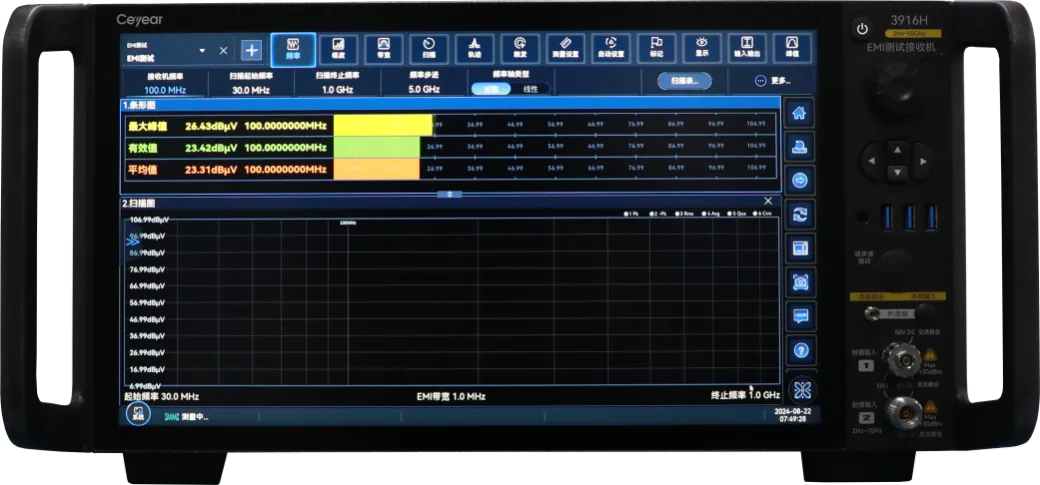
  • 3916 series EMI test receiver, front view (3916H shown)
    EMI & Monitoring ReceiversBenchtop

    3916 Series EMI Test Receiver

    3916B/D/E/F/H · 5 models

    Compliance-grade EMI test receiver up to 8.4, 18, 26.5, 45 or 50 GHz for GB/T 6113, GJB 151 and CISPR testing, with FFT time-domain scan and 400 MHz real-time analysis.

    Frequency
    50 GHz
    Real-time BW
    400 MHz
    View details
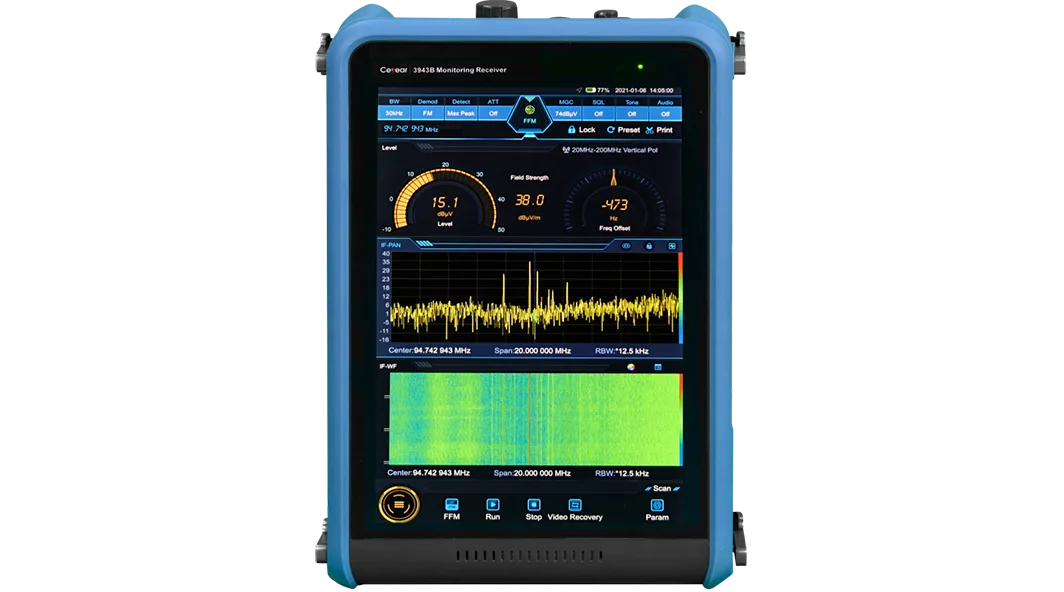
  • 3943B handheld monitoring receiver, front view
    EMI & Monitoring ReceiversHandheld

    3943B Handheld Monitoring Receiver

    3943B

    Handheld 9 kHz – 8 GHz monitoring receiver with 20 MHz analysis bandwidth, direction finding from 20 MHz to 6 GHz and three parallel processing channels.

    Frequency
    9 kHz – 8 GHz
    Analysis BW
    20 MHz
    View details

About EMI & Monitoring Receivers

Receivers in this category serve two related roles. An EMI test receiver measures conducted and radiated emissions from equipment against EMC limits, using the standardized IF bandwidths and the peak, quasi-peak and average detectors defined in CISPR 16. A monitoring receiver supports spectrum management: it scans bands, measures field strength, demodulates signals and, with direction-finding antennas, locates transmitters and interference sources. Both depend on high sensitivity, robust overload handling and accurate amplitude measurement.

Two receivers are offered. The 3916 EMI receiver covers 2 Hz up to 8.4, 18, 26.5, 45 or 50 GHz depending on the model, with CISPR-compliant detectors, EMI filters from 1 Hz to 10 MHz, and FFT time-domain scanning with up to 32768 points to shorten emission scans. The 3943 is a handheld monitoring receiver covering 9 kHz to 8 GHz, with direction finding from 20 MHz to 6 GHz, up to 20 MHz analysis bandwidth and three parallel processing channels.

How to choose

  1. 01

    Standards and detectors

    For compliance work, confirm the receiver supports the CISPR bandwidths (200 Hz, 9 kHz, 120 kHz and 1 MHz) and the detectors required by the standards you test to. The 3916 lists CISPR, GB/T 6113 and GJB 151 among its supported references.

  2. 02

    Upper frequency

    Commercial radiated-emission limits usually extend to 1 GHz or 6 GHz, depending on the highest internal frequency of the product. Military, aerospace and some automotive programs may require 18 GHz, 40 GHz or more. Choose the 3916 model that covers your upper limit.

  3. 03

    Scan speed

    FFT time-domain scanning measures many frequencies in parallel, significantly shortening quasi-peak and average scans compared with stepped scanning. Compare FFT points, overlap and stated amplitude accuracy; the 3916 specifies amplitude error below 0.4 dB in this mode.

  4. 04

    Monitoring and direction finding

    For spectrum monitoring, weigh portability and battery time, the direction-finding frequency range, analysis bandwidth and whether spectrum, level and demodulation can run in parallel channels.

Frequently asked questions

Request a Consultation

Can I use a spectrum analyzer instead of an EMI receiver?

For pre-compliance checks and troubleshooting, a spectrum analyzer with EMI bandwidths and detectors is often adequate. Full compliance testing generally calls for a receiver that meets CISPR 16-1-1, including its requirements on preselection, overload behavior and amplitude accuracy. If your lab issues formal test reports, verify the receiver against the standard and your accreditation requirements before deciding.

What is FFT time-domain scanning?

Instead of tuning to one frequency at a time and waiting out each detector dwell, the receiver captures a block of spectrum and uses FFT processing to apply EMI filters and detectors to thousands of frequency bins at once. Overlapping captures preserve the response to impulsive signals. The result is much shorter scans with results comparable to stepped scanning when the implementation meets CISPR requirements.

How do I request a quotation for an EMI or monitoring receiver?

Use the contact form to describe the standards you test to or the monitoring task, the frequency range, any accessories you need (antennas, LISNs, preamplifiers), quantity and destination country. SeaGOAT's sales team reviews the request and replies with a quotation or with questions to make sure the proposed configuration fits your application.