Skip to content
SeaGOAT Electronics logo

Solid-State Power Amplifiers

3871 broadband amplifiers for high-level test signals

1 product family

1 instrument family

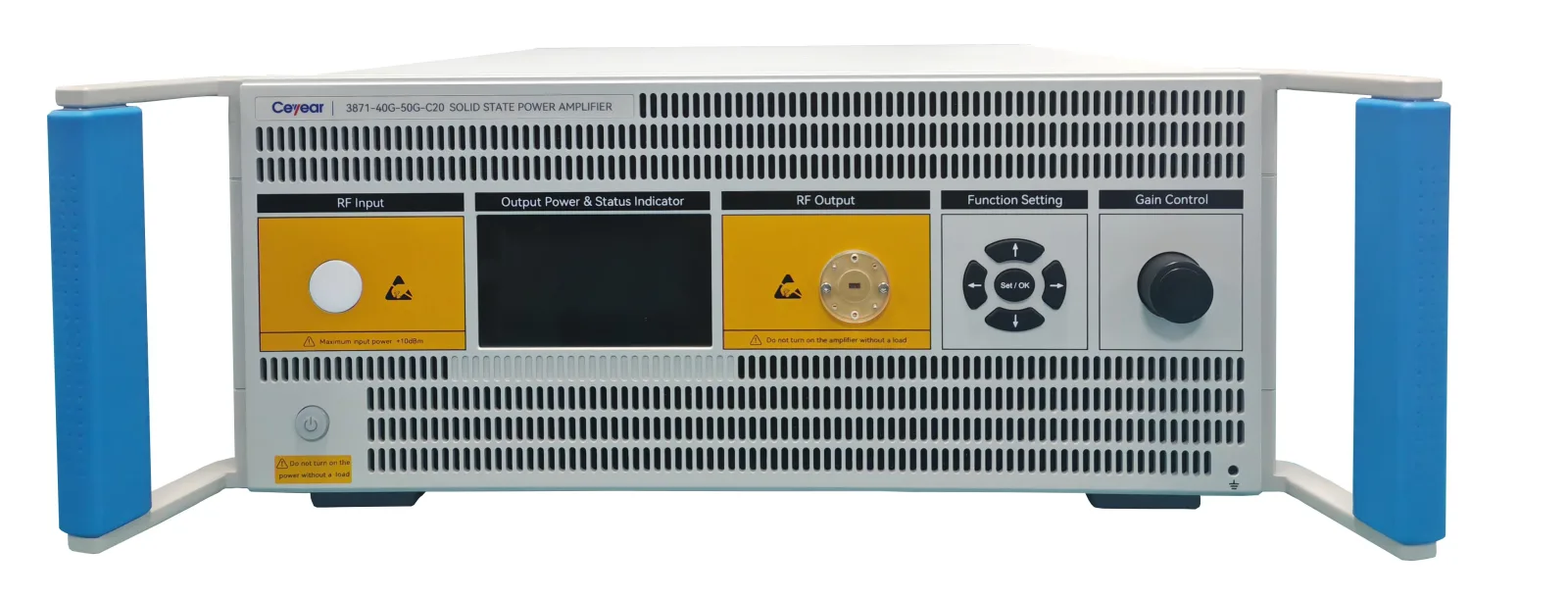
  • 3871 series solid-state power amplifier, front view (3871-40G-50G-C20 unit shown)
    Solid-State Power AmplifiersBenchtop

    3871 Series Solid-State Power Amplifier

    3871 Series · 24 models

    Broadband solid-state power amplifiers for RF to millimeter-wave bands, with high gain, output power display, adjustable gain, power leveling and GPIB/LAN remote control.

    Frequency
    4 kHz – 170 GHz
    Max. output
    +65.5 dBm
    View details

About Solid-State Power Amplifiers

Even high-power signal generators deliver at most around a watt, which is not enough for many tests. A solid-state power amplifier raises the level to watts or hundreds of watts so that you can generate field strength in radiated immunity tests, drive high-power components into compression, characterize nonlinear behavior, or overcome the losses of long cable runs and millimeter-wave setups. Bandwidth, saturated output power, gain flatness and protection features determine how flexible a test system will be.

The 3871 series divides coverage into bands, from 4 kHz–250 MHz at the low end up to 110–170 GHz. Saturated output options reach 65.5 dBm in the 10 kHz–100 MHz band, 43–50 dBm across 2–18 GHz, 33–40 dBm at 75–110 GHz and 20 dBm at 110–170 GHz. The amplifiers include a real-time output power display in dBm or W, adjustable gain, automatic level control, multiple alarm protections and remote control.

How to choose

  1. 01

    Frequency band

    A single ultra-wideband amplifier, such as a 2–18 GHz or 18–40 GHz unit, reduces band switching in automated systems. Narrower bands usually provide more output power for the same budget, so map your test frequencies before choosing.

  2. 02

    Saturated power and linearity

    Saturated output is the maximum the amplifier can deliver; linear output (around P1dB) is lower. If you amplify modulated signals or AM immunity waveforms, size the amplifier so the peaks stay within its linear region, not just the average level.

  3. 03

    Protection and control

    High-power amplifiers must survive mismatched loads, overdrive and thermal stress. Look for alarm protections, gain or power adjustment, output power display and remote control for integration into automated test systems.

Frequently asked questions

Request a Consultation

How much amplifier power do I need for a radiated immunity test?

In the far field, field strength is approximately E = √(30·P·G)/d, with P in watts, G the antenna gain and d the distance in meters. Add cable loss, and remember that 80% AM modulation raises peak power by about 5.1 dB over the unmodulated level. Chamber calibration data gives the real figure, but this estimate shows why immunity amplifiers are often rated in tens or hundreds of watts.

Can a 3871 amplifier be configured for a specific band or power level?

The 3871 series is offered in many band and output power combinations, and customized development is also listed. If the standard combinations do not match your needs, describe the frequency band, required output power, gain and interface requirements, and we will check the available options with you.

How do I request a quotation for a power amplifier?

Use the contact form to send the frequency band, required output power (saturated or linear), the application (EMC immunity, component testing, transmitter simulation), signal type, quantity and destination country. SeaGOAT's sales team reviews the request and replies with a quotation or with questions to confirm the right band and power option.