Skip to content
SeaGOAT Electronics logo

Signal & Spectrum Analyzers

Analyzers for RF, microwave and mmWave signal analysis

4 product families

4 instrument families

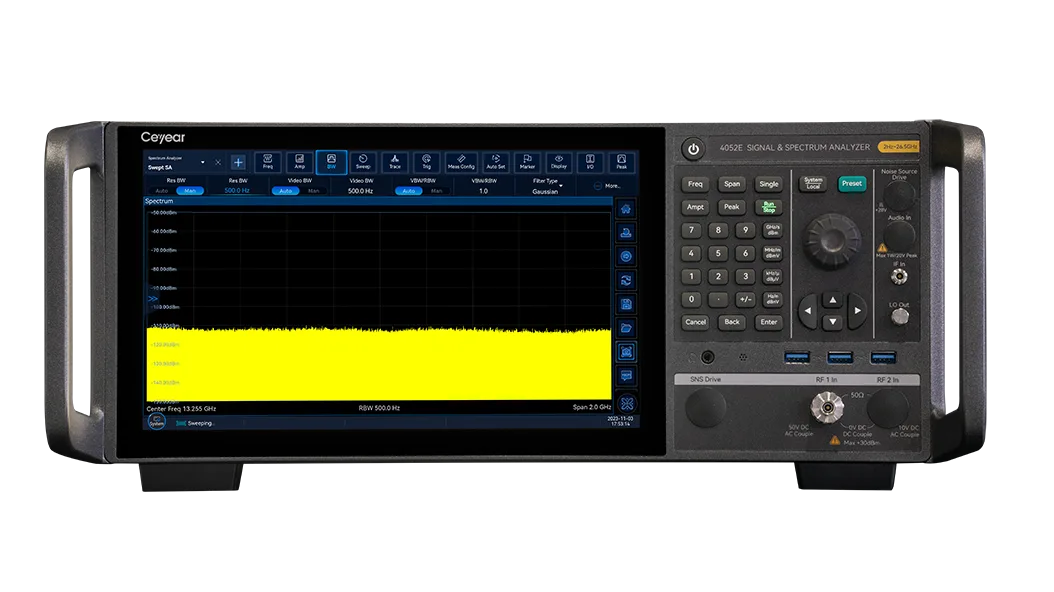
  • 4052 series signal and spectrum analyzer, front view (4052E shown)
    Signal & Spectrum AnalyzersBenchtop

    4052 Series Signal and Spectrum Analyzer

    4052A/B/C/D/E/F/G/H · 8 models

    Mid-range signal and spectrum analyzer covering 2 Hz – 50 GHz in eight models, with up to 1.2 GHz analysis bandwidth and -154 dBm/Hz DANL at 1 GHz.

    Frequency
    2 Hz – 50 GHz
    Analysis BW
    1.2 GHz
    View details
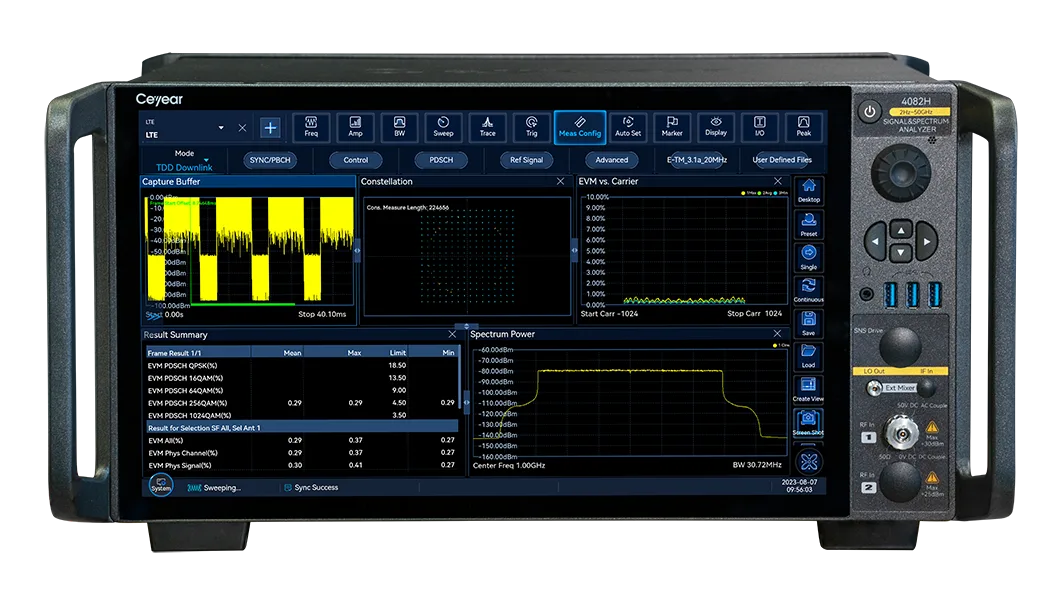
  • 4082 series signal and spectrum analyzer, front view (4082H shown)
    Signal & Spectrum AnalyzersBenchtop

    4082 Series Signal and Spectrum Analyzer

    4082B/D/E/F/H/L/N/P · 8 models

    Flagship signal and spectrum analyzer: 2 Hz – 110 GHz coaxial coverage, up to 2 GHz analysis bandwidth and 1.2 GHz real-time analysis.

    Frequency
    2 Hz – 110 GHz
    Analysis BW
    2 GHz
    View details
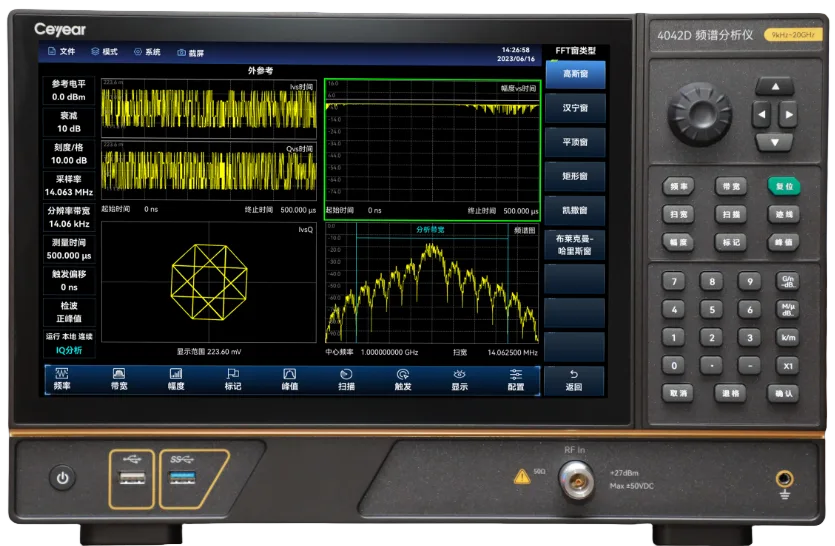
  • 4042 series spectrum analyzer, front view (4042D shown)
    Signal & Spectrum AnalyzersPortable

    4042 Series Spectrum Analyzer

    4042B/D · 2 models

    Portable 9 kHz – 20 GHz spectrum analyzer under 6.5 kg with standard full-band preamplifier, -163 dBm/Hz typical DANL and optional 40 MHz real-time analysis.

    Frequency
    9 kHz – 20 GHz
    Real-time BW
    40 MHz
    View details
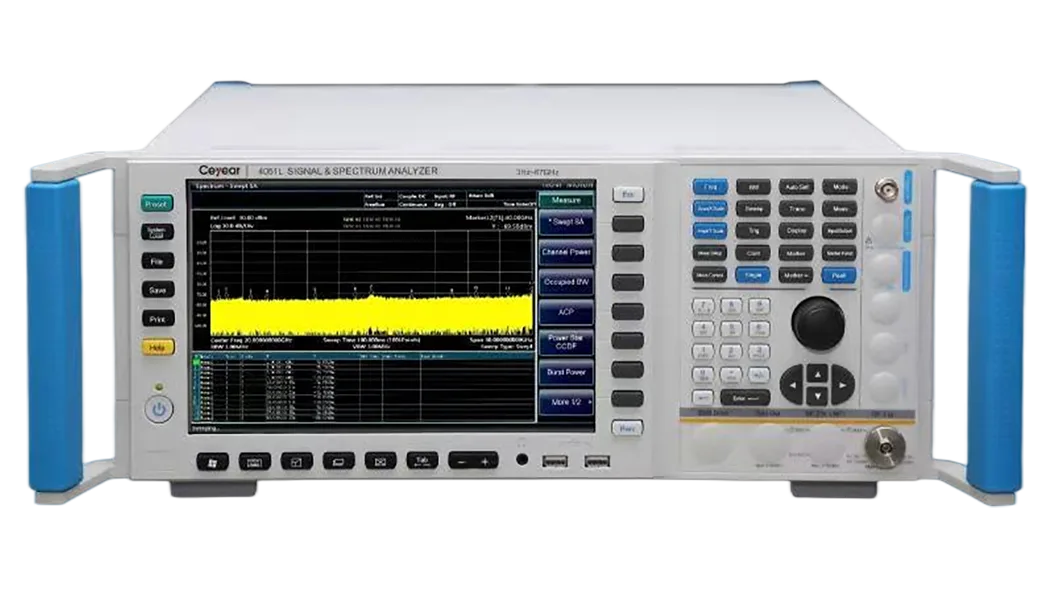
  • 4051 series signal and spectrum analyzer, front view (4051L shown)
    Signal & Spectrum AnalyzersBenchtop

    4051 Series Signal and Spectrum Analyzer

    4051A/B/C/D/E/F/G/H/L/N · 10 models

    High-performance signal and spectrum analyzer covering 3 Hz – 85 GHz in ten models, with up to 1 GHz analysis bandwidth and 4 GB capture memory.

    Frequency
    3 Hz – 85 GHz
    Analysis BW
    1 GHz
    View details

About Signal & Spectrum Analyzers

A spectrum analyzer displays signal power versus frequency, revealing carriers, harmonics, spurious emissions, intermodulation products and the noise floor. Modern signal analyzers go further: they digitize a wide slice of spectrum and process it, so the same instrument measures channel power, ACLR and occupied bandwidth, demodulates 5G NR or LTE signals to report EVM, characterizes radar pulses and captures transient events in real time. Sensitivity (DANL), phase noise and analysis bandwidth determine which of these tasks an analyzer handles well.

Four families are available. The flagship 4082 covers 2 Hz to 110 GHz, offers analysis bandwidth options up to 2 GHz and a typical DANL of −154 dBm/Hz at 1 GHz. The 4051 spans 3 Hz to 85 GHz, extendable to 500 GHz with external frequency extension, with up to 1 GHz analysis bandwidth. The mid-range 4052 reaches 50 GHz with up to 1.2 GHz analysis bandwidth and real-time analysis, and the portable 4042 covers 9 kHz to 20 GHz with 40 MHz real-time bandwidth.

How to choose

  1. 01

    Frequency range and extension

    Size the analyzer for the highest fundamental and harmonic you must observe: checking the third harmonic of a 30 GHz signal needs 90 GHz of coverage. Beyond the coaxial range, external mixers extend some families into the sub-THz region; the 4082 is specified up to 750 GHz with external extension.

  2. 02

    DANL and phase noise

    DANL sets the smallest signal you can detect at a given RBW, while phase noise limits measurements close to a strong carrier. Compare both at your frequency of interest and decide whether you need a preamplifier: on the 4082 it improves typical DANL at 1 GHz from −154 to −167 dBm/Hz.

  3. 03

    Analysis and real-time bandwidth

    A modulated signal must fit inside the analysis bandwidth to be demodulated in one capture. 5G NR FR2 and wideband radar chirps call for hundreds of MHz or more. Real-time bandwidth and minimum duration for 100% probability of intercept matter when you hunt short, intermittent bursts.

  4. 04

    Measurement applications

    List the analysis functions you need, such as 5G NR, LTE, WLAN, pulse, FMCW, phase noise or noise figure, and confirm they are available for the chosen family. Many are configured as options, so include them when you request a quotation.

Frequently asked questions

Request a Consultation

What is the difference between a signal analyzer and a spectrum analyzer?

A classic swept spectrum analyzer measures power versus frequency. A signal analyzer adds a wide digitized IF bandwidth and software that examines the signal in the time, frequency and modulation domains: EVM, constellations, pulse parameters and transient behavior. The benchtop families listed here combine both roles, and the analysis bandwidth you choose determines how wide a signal can be analyzed in a single capture.

How much analysis bandwidth do I need for 5G NR?

The analysis bandwidth must exceed the occupied bandwidth of the signal under test. 5G NR carriers reach 100 MHz in FR1 and 400 MHz in FR2, and carrier aggregation widens that further. For FR1 a few hundred MHz is usually enough; for FR2 or aggregated carriers, look at the 1.2 GHz options of the 4052 and 4082, or the 2 GHz option of the 4082.

Can a spectrum analyzer also measure noise figure and phase noise?

Yes. The 4082 and 4051 list noise figure and phase noise among their measurement functions, and the 4052 and 4042 offer phase noise measurement. For dedicated, high-accuracy noise figure work on low-noise amplifiers and multi-stage converters, a dedicated instrument such as the 3986 noise figure analyzer, with its built-in uncertainty calculator, is often the better tool.

How do I get a quotation or help choosing an analyzer?

Use the contact form to tell us the frequency range, the analysis bandwidth and measurement functions you need, quantity and destination country. If you are unsure, describe the signals you work with, for example 5G NR carriers, radar pulses or satellite links. SeaGOAT's sales team reviews the information and replies with a proposed configuration and quotation, or with questions to clarify the requirements.