Optical communications span two very different worlds. In the field, operators and contractors build and maintain fiber networks, from long-haul backbones to FTTH access, where the challenges are low splice loss, fast installation and quick location of faults. In the lab, component and module makers develop the lasers, modulators and photodetectors that carry ever higher data rates, where the challenge is measuring optical spectra and high-frequency modulation response accurately.
For deployment, fusion splicers with core or cladding alignment join fibers with typical losses of a few hundredths of a dB, and OTDRs verify every link, mapping splices, connectors and bends with their distance and loss. Built-in visual fault locators, power meters and light sources reduce the number of separate tools a technician needs, and wavelength options at 1625 nm or 1650 nm support testing outside the traffic band.
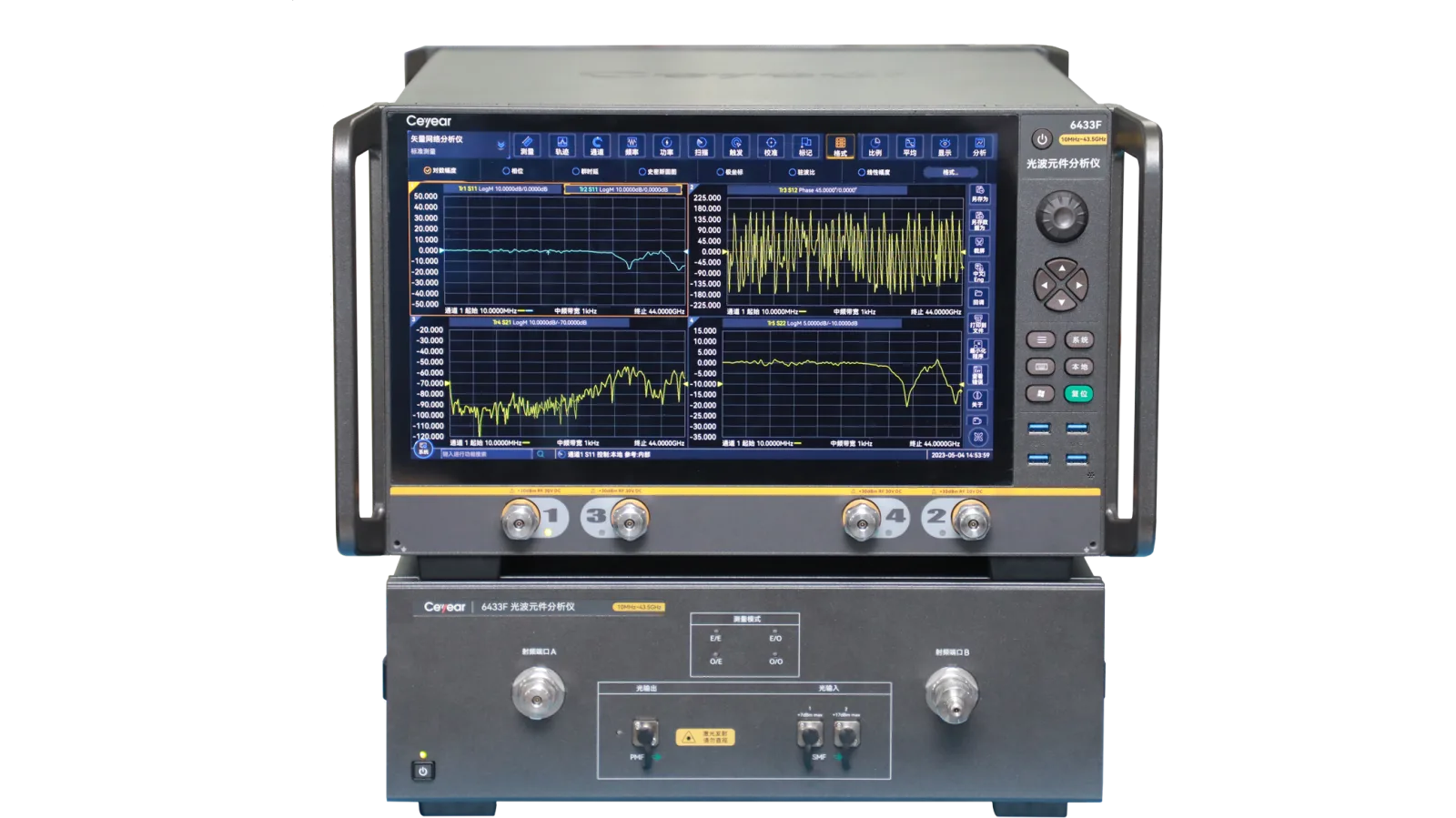
For component development, optical spectrum analyzers measure laser wavelength, side-mode suppression and WDM channel characteristics, while a tunable laser source sweeps passive components such as filters and gratings. Lightwave component analyzers measure the E/O and O/E response of high-speed lasers, modulators and photodiodes, and the 6433 reaches 110 GHz to cover the bandwidths that current and next-generation optical links require.