Skip to content
SeaGOAT Electronics logo
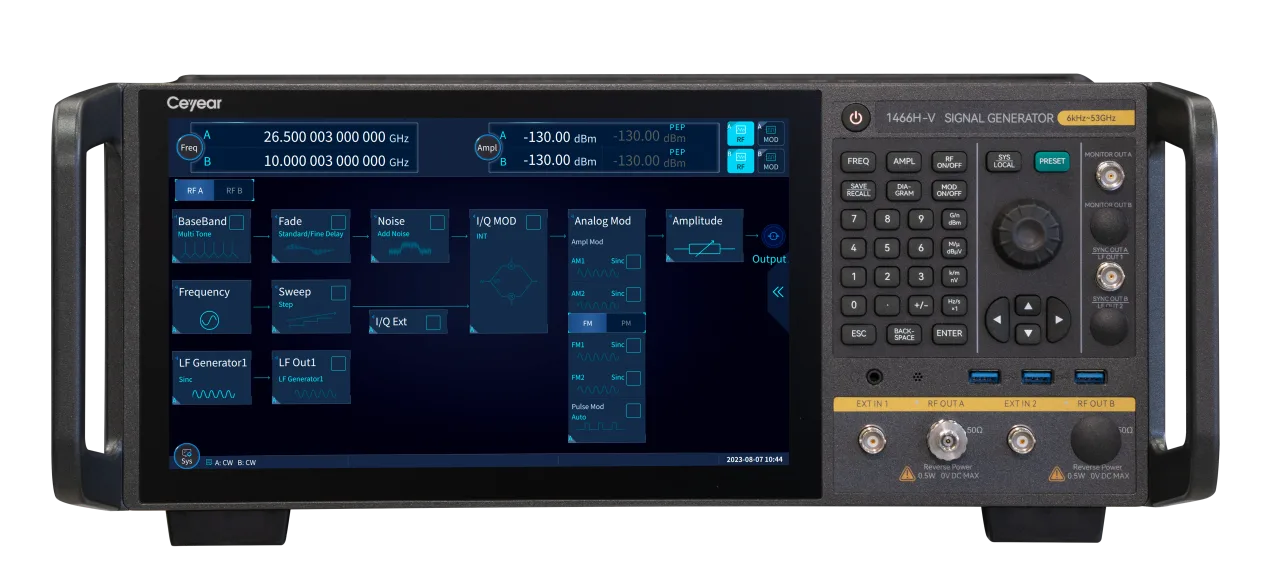
1466H-V vector signal generator, front view
Signal GeneratorsBenchtop

1466-V Series Vector Signal Generator

Model
1466C/D/E/G/H/L-V
Supplied by
SeaGOAT Electronics
Frequency
6 kHz – 67 GHz

Vector signal generator from 6 kHz to 67 GHz with up to 2 GHz internal modulation bandwidth, high output power, low phase noise and 5G NR, WLAN and radar signal simulation.

Key highlights

  • 6 kHz – 67 GHz in six models, with optional second vector channel on 13/20 GHz models
  • Up to 2 GHz internal and 5 GHz external RF modulation bandwidth
  • 0.4 % measured QPSK EVM at 2 GHz; 5G NR ACPR < -55 dBc at 2 GHz (typ.)
  • Typical SSB phase noise -132 dBc/Hz at 10 kHz offset, 10 GHz carrier
  • Typical max. output +27 dBm at 5 GHz and 170 dB output dynamic range
  • Real-time fading with up to 20 paths and 3GPP channel models

Supplied by SeaGOAT Electronics, an independent international supplier of electronic test and measurement equipment. SeaGOAT Electronics does not manufacture this equipment; it is sourced through our manufacturing and supply partners.

Specifications

Frequency
Frequency range6 kHz – 67 GHz (model dependent, see variants)
Frequency resolution0.001 Hz
Frequency switching time< 15 ms
Time base aging rate (typ.)±5 × 10⁻¹⁰/day after 30 days warm-up
Reference output10 MHz, > +4 dBm (50 Ω)
Reference input1 – 100 MHz in 1 Hz steps, -5 dBm to +10 dBm, 50 Ω
Sweep modesStep, list; ramp (analog) sweep with option S15 (max. 400 MHz/ms above 4 GHz); power sweep with option S16
Output power
Max. output power (typ., CW)+27 dBm @ 5 GHz +24 dBm @ 20 GHz +25 dBm @ 30 GHz +22 dBm @ 60 GHz
Max. output power (specified)Model and option dependent; see variants
Min. output powerStandard: -10 dBm (settable to -20 dBm) 1466C/D/E/G-V with H01-130: -120 dBm (settable to -150 dBm) 1466H/L-V with H01-90/H01-120: -90 dBm (settable to -110/-140 dBm)
Output power dynamic rangeUp to 170 dB
Level accuracy (-10 dBm < P ≤ +25 dBm, 25 ±10 °C)±0.5 dB (50 MHz – 3 GHz) ±0.9 dB (3 – 20 GHz) ±1.0 dB (20 – 40 GHz) ±1.3 dB (40 – 50 GHz) ±1.8 dB (50 – 67 GHz)
Power resolution0.01 dB
VSWR (internally leveled, typ.)< 1.6 (100 kHz – 20 GHz) < 1.8 (20 – 40 GHz) < 2.0 (40 – 67 GHz)
Maximum reverse power0.5 W (0 V DC, nom.)
Spectral purity
SSB phase noise (typ.)-145 dBc/Hz @ 10 kHz offset, 1 GHz carrier -132 dBc/Hz @ 10 kHz offset, 10 GHz carrier
Wideband noise floor (typ.)-161 dBc/Hz @ 30 MHz offset, 20 GHz carrier
SSB phase noise, 4 – 10 GHz, 10 kHz offset (spec.)Standard: < -110 dBc/Hz Option H04-1 (low phase noise): < -120 dBc/Hz Option H04-2 (ultra-low phase noise): < -128 dBc/Hz
Harmonics (at +10 dBm or max. specified power)< -30 dBc (6 kHz – 3 GHz) < -55 dBc (3 – 67 GHz)
Vector modulation and baseband
Internal RF modulation bandwidth500 MHz (option H31-500), 1 GHz (option H31-1000), 2 GHz (option H31-2000)
External I/Q modulation bandwidth2 GHz standard; 5 GHz with option H33 (f > 20 GHz)
EVM, QPSK (measured)0.4 % @ 2 GHz carrier
EVM, QPSK 4 Msym/s (spec., RMS)< 0.8 % (100 MHz – 4 GHz) < 1.0 % (4 – 20 GHz) < 1.2 % (20 – 40 GHz) < 1.4 % (40 – 67 GHz)
EVM, 5G NR TM3.1a, 100 MHz, 256QAM (option S01)< 0.85 % @ 3.5 GHz < 1.0 % @ 10 GHz < 1.2 % @ 28 GHz < 1.8 % @ 42.5 GHz
5G NR ACPR (typ.)< -55 dBc @ 2 GHz < -45 dBc @ 42.5 GHz
Max. symbol rate150 Msps standard; 300 Msps (H31-1000); 600 Msps (H31-2000)
Baseband waveform memory1 G samples standard; 4 G samples with option H32
Real-time modulation formatsPSK (BPSK to 8PSK), QAM (16 to 4096), FSK (2 to 64), ASK, MSK, APSK, arbitrary waveform
Fading simulationReal-time, up to 20 paths: pure Doppler, Rayleigh, Rice, Rayleigh + lognormal; 3GPP channel models
Signal standards (software options)5G NR (R16), LTE/LTE-Advanced, GSM/EDGE, NB-IoT, WLAN 802.11a/b/g/n/ac/ax and 802.11be, Bluetooth BR/EDR/LE, DVB-H/T/T2/S2/S2X
Other baseband functionsAWGN and CW interference, multitone and multicarrier, intrapulse modulation (LFM, Barker, phase codes), frequency hopping
Modulation
Analog modulation (option S11)AM, FM, ΦM
Pulse modulation (f > 50 MHz)Option S12: on/off > 80 dB, rise/fall < 20 ns, min. width 0.1 µs Option S13: on/off > 80 dB, rise/fall < 10 ns, min. width 20 ns
Complex pulse functionsDouble pulse, pulse train, PRF jitter, PRF stagger, PRF sliding
General
RF channels1 standard; optional vector channel B (6 kHz – 13/20 GHz, options H11-BV13/BV20); multi-instrument cascading with phase coherence (option H36) for MIMO and beamforming
Display11.6-inch high-resolution touch screen
Dimensions (W × H × D)426 × 177 × 500 mm (without handles and bumpers) 475 × 193 × 620 mm (with handles and bumpers)
Weight< 35 kg (model and option dependent)
Power supply100 – 120 VAC or 200 – 240 VAC, 50/60 Hz (auto-ranging)
Power consumption< 700 W
Operating temperature0 °C – +50 °C
Storage temperature-40 °C – +70 °C

Overview

The 1466-V is a high-performance vector signal generator that combines the microwave hardware of the 1466 platform with a wideband baseband. Six models cover 6 kHz up to 13, 20, 33, 45, 53 or 67 GHz, with internal RF modulation bandwidths of 500 MHz, 1 GHz or 2 GHz and up to 5 GHz using external wideband I/Q input.

Signal quality is suited to demanding component and system tests: typical SSB phase noise is -132 dBc/Hz at 10 kHz offset on a 10 GHz carrier, typical maximum output reaches +27 dBm at 5 GHz, and the output dynamic range reaches 170 dB. QPSK EVM was measured at 0.4 % on a 2 GHz carrier, and typical 5G NR ACPR is better than -55 dBc at 2 GHz.

The baseband generates more than 30 standard digital modulation formats, plays back arbitrary waveforms with variable sample rate, and adds multicarrier, noise, intrapulse modulation and real-time fading with up to 20 paths. Software options add 5G NR, LTE, NB-IoT, WLAN up to 802.11be, Bluetooth and DVB signal simulation, and several units can be cascaded with phase coherence for MIMO and beamforming tests.

Applications

  • RF conformance testing of 5G NR base stations and terminals
  • WLAN (Wi-Fi 6/Wi-Fi 7) and Bluetooth device development and production test
  • Radar signal simulation with intrapulse modulation and complex pulse patterns
  • MIMO, beamforming and diversity testing with cascaded phase-coherent units
  • Wideband component and module testing at microwave and millimeter-wave frequencies

Available models

Specifications differ between models. Select a model to include it in your inquiry.

ModelRangeModel-specific valuesContact Sales
1466C-V6 kHz – 13 GHz
Max. output power, standard:
≥ +15.0 dBm
Max. output power, option H05 (high power):
≥ +20.0 dBm (50 MHz – 13 GHz)
RF output connector:
3.5 mm (male), 50 Ω
1466D-V6 kHz – 20 GHz
Max. output power, standard:
≥ +15.0 dBm
Max. output power, option H05 (high power):
≥ +20.0 dBm (50 MHz – 20 GHz)
RF output connector:
3.5 mm (male), 50 Ω
1466E-V6 kHz – 33 GHz
Max. output power, standard:
≥ +12.0 dBm (50 MHz – 33 GHz)
Max. output power, option H05 (high power):
≥ +20.0 dBm (50 MHz – 6 GHz) ≥ +18.0 dBm (6 – 18 GHz) ≥ +17.0 dBm (18 – 30 GHz) ≥ +18.0 dBm (30 – 33 GHz)
RF output connector:
2.4 mm (male), 50 Ω
1466G-V6 kHz – 45 GHz
Max. output power, standard:
≥ +12.0 dBm (50 MHz – 45 GHz)
Max. output power, option H05 (high power):
≥ +20.0 dBm (50 MHz – 6 GHz) ≥ +18.0 dBm (6 – 18 GHz) ≥ +17.0 dBm (18 – 30 GHz) ≥ +18.0 dBm (30 – 40 GHz) ≥ +14.0 dBm (40 – 45 GHz)
RF output connector:
2.4 mm (male), 50 Ω
1466H-V6 kHz – 53 GHz
Max. output power, standard:
≥ +8.0 dBm
Max. output power, option H05 (high power):
≥ +17.0 dBm (50 MHz – 35 GHz) ≥ +15.0 dBm (35 – 40 GHz) ≥ +20.0 dBm (40 – 53 GHz)
RF output connector:
1.85 mm (male), 50 Ω
1466L-V6 kHz – 67 GHz
Max. output power, standard:
≥ +8.0 dBm
Max. output power, option H05 (high power):
≥ +17.0 dBm (50 MHz – 35 GHz) ≥ +15.0 dBm (35 – 40 GHz) ≥ +20.0 dBm (40 – 53 GHz) ≥ +18.0 dBm (53 – 65 GHz) ≥ +15.0 dBm (65 – 67 GHz)
RF output connector:
1.85 mm (male), 50 Ω

Documents and datasheets

Original datasheets, manuals and application documents for this equipment are available from our sales team.

  • Datasheet · EN
  • User manual · EN
  • Programming manual · EN
Request the datasheet

Request a quote for the 1466C/D/E/G/H/L-V

Tell us your requirements and our sales team will reply with configuration options and a written quotation. The exact model number is included automatically. No prices or online ordering on this site.

Buying for a facility in the United States or Canada? How quotations, shipping and import documents work

We use your details only to answer this inquiry. No newsletters.

Specifications are compiled from the manufacturer’s official product information and the SeaGOAT catalog. Last verified November 17, 2026. Specifications may change; please confirm the exact configuration with our sales team before ordering. Verified against manufacturer data.

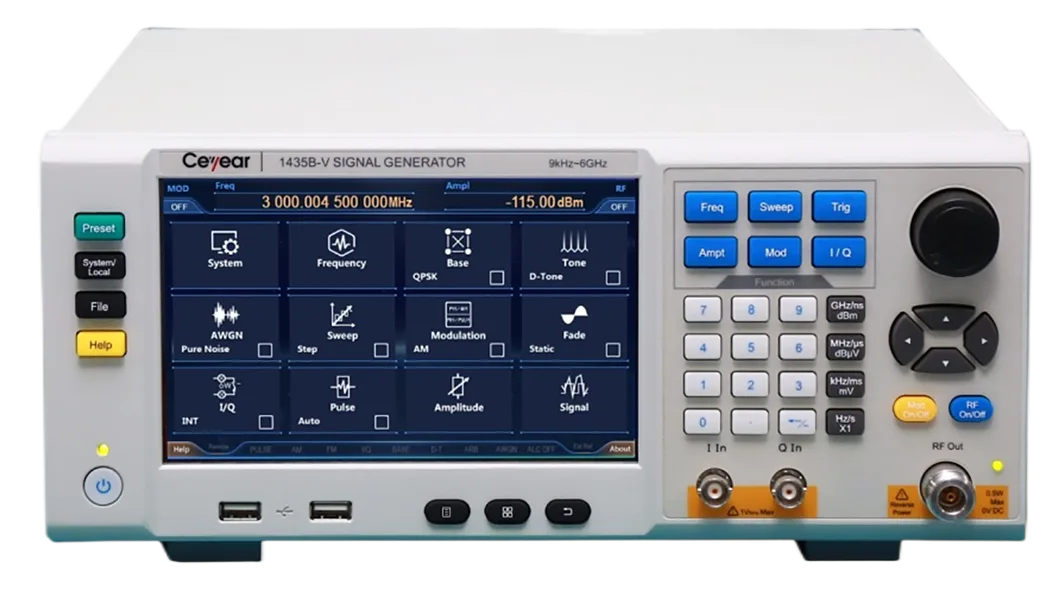
1435B-V vector signal generator, front view
Signal GeneratorsPortable

1435-V Series Vector Signal Generator

1435A/B-V · 2 models

Compact 3U vector signal generator covering 9 kHz to 6 GHz, with up to 200 MHz internal modulation bandwidth, over 20 digital modulation formats and arbitrary waveform playback.

Frequency
9 kHz – 6 GHz
Analysis BW
200 MHz
Max. output
+22 dBm
View details
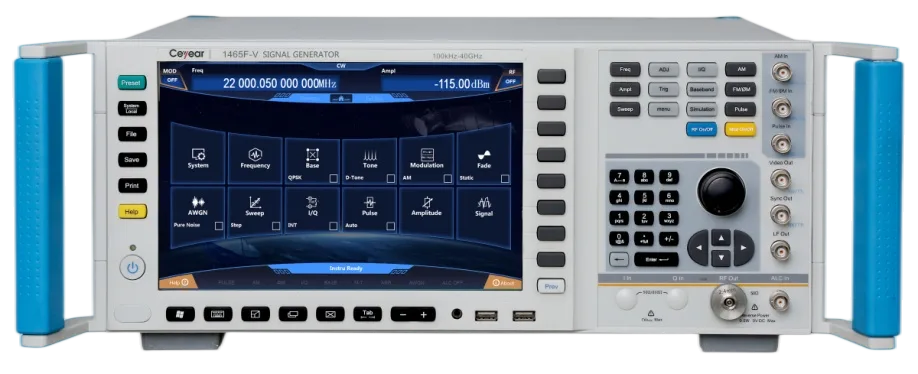
1465F-V vector signal generator, front view
Signal GeneratorsBenchtop

1465-V Series Vector Signal Generator

1465C/D/F/H/L-V · 5 models

Vector signal generator from 100 kHz to 67 GHz with up to 1 GHz internal and 2 GHz external modulation bandwidth, EVM below 1.4 % up to 40 GHz and low phase noise.

Frequency
100 kHz – 67 GHz
Analysis BW
1 GHz
Max. output
+20 dBm
View details
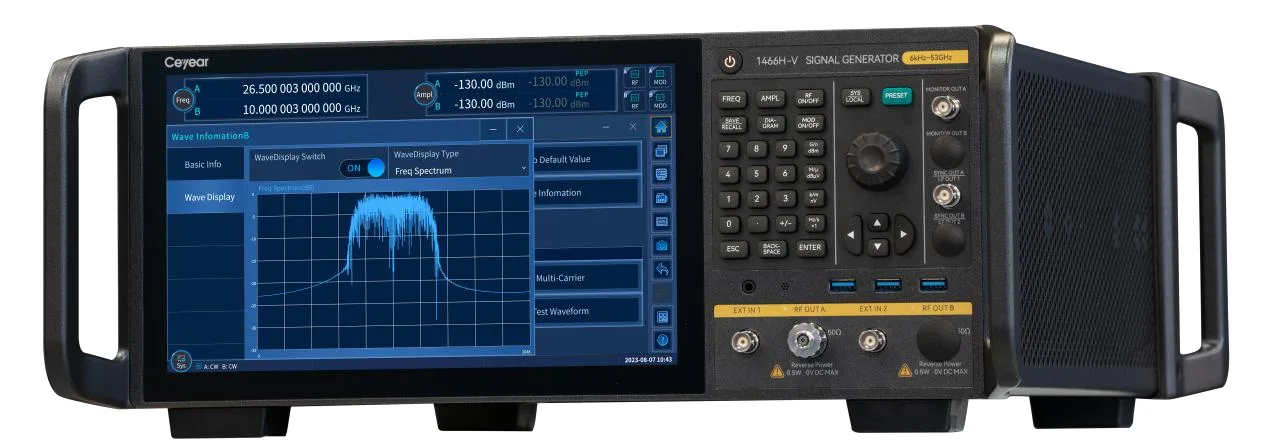
1466 series signal generator, three-quarter front view (1466H-V unit shown)
Signal GeneratorsBenchtop

1466 Series Analog Signal Generator

1466C/D/E/G/H/L/N/P · 8 models

Analog microwave signal generator covering 6 kHz to 110 GHz, with low phase noise, high output power, AM/FM/ΦM and pulse modulation, and an optional second RF channel.

Frequency
6 kHz – 110 GHz
Max. output
+27 dBm
View details
Request a Quote